

The Professional's Guide to Hi-Vis Jackets: Standards, Durability, and Choice
How many times have you binned a hi vis jacket because the zip seized in the first frost or the reflective strips peeled off after three washes? It's a common frustration on British sites where "waterproof" often means sweating like you're in a sauna and "durable" means it might last until Tuesday. You deserve gear that works as hard as you do. Substandard equipment isn't just a waste of money. It is a genuine safety risk when your visibility starts to fade under the grime of a demanding shift.
Your workwear is a tool, not just a uniform. Its value is measured by its ability to maintain compliance under extreme physical stress. This guide will help you master the technical requirements of professional high-visibility apparel so you can select a jacket that actually survives the rigours of the job. You will learn how to choose gear that stays bright, stays dry, and keeps you comfortable for the full 12 hours. We'll break down the confusion surrounding EN ISO 20471 classes and ensure you remain fully compliant with UK safety laws without sacrificing performance.
Key Takeaways
- Decode EN ISO 20471 classes to ensure your workwear provides total compliance with UK safety laws and site-specific regulations.
- Identify the high-denier fabrics and reinforced seams required to stop a hi vis jacket from tearing under the physical stress of a demanding shift.
- Match your jacket style-be it a parka, bomber, or softshell-to your specific activity level to ensure maximum range of motion around machinery.
- Learn why every garment has a "max wash" limit and how to protect reflective strips from the degrading effects of site dirt and grease.
- Master layering techniques that keep you dry and visible throughout a 12-hour shift without the discomfort of non-breathable waterproofs.
Understanding Hi-Vis Standards: More Than Just a Colour
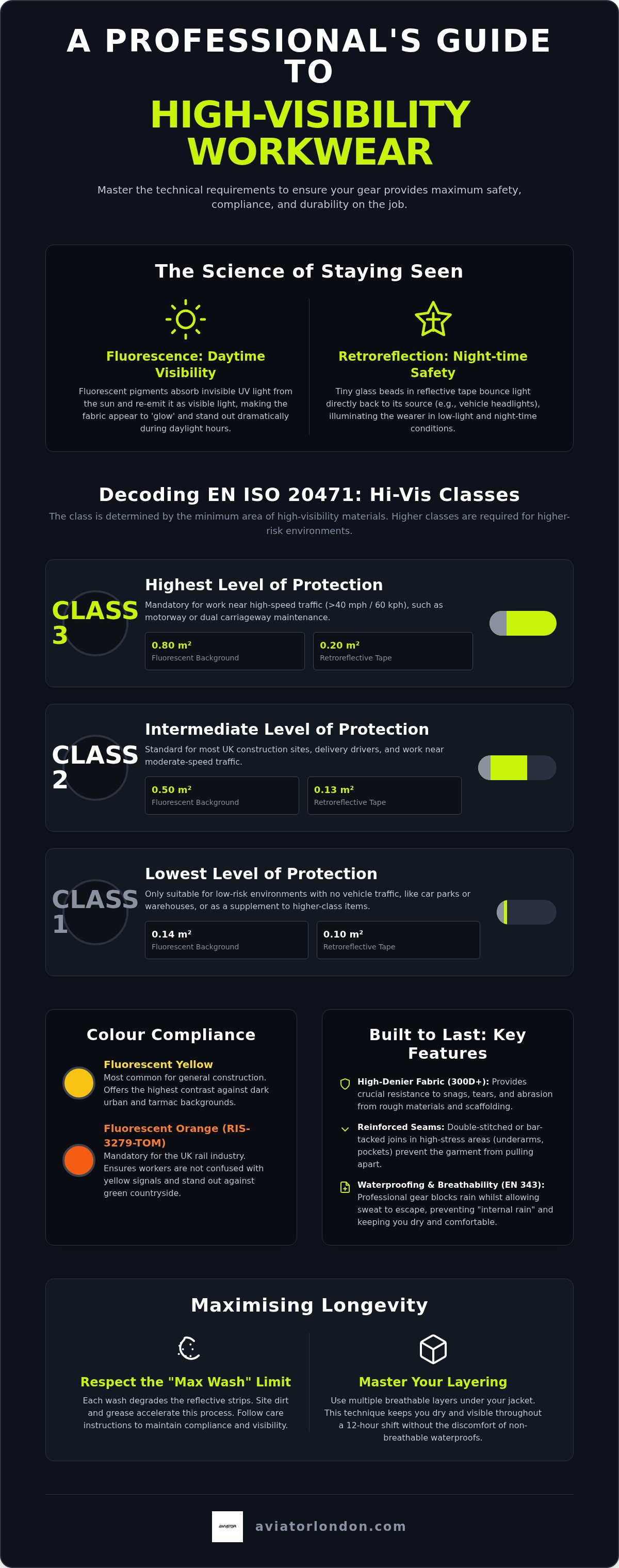
Wearing a hi vis jacket isn't a suggestion on a UK site; it's a legal mandate under the Personal Protective Equipment at Work Regulations. If you're caught without the correct gear, you aren't just risking a site fine. You're risking your life. The effectiveness of your workwear relies on two distinct scientific principles: fluorescence and retroreflection. Fluorescent pigments absorb invisible ultraviolet light from the sun and re-emit it as visible light, making the fabric appear to glow during the day. When the sun goes down, the retroreflective tape takes over. It uses thousands of tiny glass beads to bounce light directly back to its source, such as a vehicle's headlights.
Understanding these High-visibility clothing standards is vital for anyone working in high-risk environments. You can't just trust that a bright colour is enough to keep you safe. Every professional garment must carry an internal tag featuring the EN ISO 20471 icon. This symbol confirms the clothing has been tested to meet specific visibility thresholds. If that tag is missing or illegible, the jacket is no longer fit for purpose as PPE. Don't guess your safety. Check the label before you start your shift.
EN ISO 20471 Classes 1, 2, and 3 Explained
The "Class" of your gear is determined by the total area of fluorescent background material and retroreflective tape. Choosing the wrong class for your environment is a common mistake that can lead to site ejections or serious accidents. The higher the speed of nearby traffic, the higher the class you need.
- Class 3: This is the highest level of protection. It requires 0.80m² of background fabric and 0.20m² of reflective tape. You'll typically see this on parkas or jackets with reflective bands on the sleeves, which help drivers identify you as a human figure from a distance. It's mandatory for high-speed road works.
- Class 2: The standard for most UK construction and delivery work. It requires 0.50m² of background material. It provides sufficient visibility for environments with moderate traffic speeds.
- Class 1: This offers the lowest visibility level. It is only suitable for low-risk, off-road environments or as a supplement to higher-class garments like hi-vis trousers.
Yellow vs Orange: The Site Requirements
The debate between yellow and orange often comes down to your specific industry. Fluorescent yellow is the most popular choice for general construction because it offers the sharpest contrast against dark urban backgrounds and grey tarmac. However, the UK rail industry follows a different rulebook. The RIS-3279-TOM standard makes fluorescent orange mandatory for all trackside workers. This specific shade ensures that personnel aren't confused with yellow railway signals and stand out clearly against the green foliage of the British countryside. Always check your site's specific safety policy before buying your next hi vis jacket to ensure you meet their colour and contrast requirements.
Rugged Construction: What Makes a Hi-Vis Jacket Last?
A cheap hi vis jacket might look the part on the first day, but it rarely survives the first month on a real site. Durability starts with the fabric's denier count. High-denier polyester, often 300D or higher, provides the structural integrity needed to resist snags from rebar or rough scaffolding. If your fabric is too thin, it becomes a liability the moment you lean against a jagged surface. Professional-grade gear also prioritises reinforced seams. Look for double-stitched or bar-tacked joins in high-stress areas like the underarms and pocket corners. Without these reinforcements, the constant movement of a 12-hour shift will eventually pull the garment apart at the threads.
Weather protection is about more than just keeping water out. It's about letting moisture escape. Cheap waterproofs often trap heat, leading to "internal rain" where you're as soaked from sweat as you would be from the downpour. This is where heavy-duty zips and storm flaps become non-negotiable. A plastic zip will snap in sub-zero temperatures, but a rugged, chunky-toothed zip protected by a double storm flap keeps the wind out and the heat in. Whilst UK regulations focus on visibility, many professionals also look toward OSHA high-visibility standards for global best practices in garment longevity and structural performance.
Waterproofing Standards (EN 343)
EN 343 is the European standard that classifies protective clothing based on its ability to resist water penetration and its level of breathability. The tag will display two numbers: the top number (X) represents water resistance, while the bottom number (Y) indicates breathability. A rating of Class 3:3 was long considered the benchmark, though Class 4:4 now offers the highest level of protection available. Truly waterproof gear requires taped seams, where a heat-sealed strip covers every stitch hole to prevent water from seeping through the needle points during a heavy British downpour.
Pockets and Functionality for Tradesmen
If you're constantly fumbling for your phone or ID, your jacket isn't doing its job. Practicality is found in the details, such as dedicated mobile phone pockets with secure Velcro closures and clear ID badge holders that don't flap in the wind. Internal storage is essential for keeping sensitive electronics dry, whilst external pockets should be deep enough to hold hand tools without them falling out when you bend over. For those who need maximum utility, choosing a jacket with reinforced holster pockets ensures you have quick access to fixings without the weight tearing the fabric. These functional elements turn a simple hi vis jacket into a piece of professional equipment that supports your productivity on site.
Selecting Your Style: Bomber, Parka, or Softshell?
Your choice of hi vis jacket should be dictated by your movement, not just the weather. If you spend your day climbing ladders or operating heavy machinery, a bulky coat is more than just an annoyance; it’s a snag hazard. Conversely, if you're standing on a static traffic point for eight hours in January, a lightweight shell is a recipe for hypothermia. You must balance thermal insulation against garment weight to ensure you stay productive without overheating. Professional safety apparel is never "one size fits all." A jacket that is too large creates loose folds of fabric that can easily be drawn into moving parts or caught on protruding scaffolding. Pick a cut that matches the physical reality of your shift.
The Hi-Vis Bomber Jacket: Agile Protection
These are the workhorses for tradespeople who need agility and speed. The short-waisted design stops at the belt line, providing immediate access to tool pouches and trousers pockets without having to lift the garment. Elasticated cuffs and waistbands are functional, not just stylistic. They trap heat effectively and keep the fabric close to the body, reducing the risk of catching on equipment. If your job involves jumping in and out of a van or cab fifty times a day, the bomber is your best bet. It provides the necessary EN ISO compliance without the restrictive length of a traditional coat.
The Hi-Vis Parka: Maximum Coverage
When the British weather turns truly hostile, the parka is the only sensible option. The longer length provides critical protection for the lower back and hips against driving rain and biting winds. For static work in sub-zero temperatures, look for heavy-duty thermal linings that maintain core heat during long periods of inactivity. Many professionals opt for a '3-in-1' parka. This versatile system features a removable inner fleece or bodywarmer, allowing you to adapt the hi vis jacket as the UK seasons shift from a freezing morning to a mild afternoon. It is the definitive choice for maximum coverage and endurance.
Softshell and Windbreakers: Versatile Mid-Layers
High-activity tasks require a different approach to temperature regulation. The hi-vis softshell has become a site favourite because it offers a windproof membrane without the restrictive bulk of a padded coat. These garments are designed to breathe, moving moisture away from the skin whilst you work. For summer safety or indoor warehouse environments, a lightweight windbreaker is often the smarter choice. It provides the required fluorescent background and reflective tape without adding unnecessary thermal weight. Choose your layer based on the energy you'll expend, not just the reading on the thermometer.
Maximising Longevity: Care and Layering Strategies
Every hi vis jacket comes with a built-in countdown. You'll find a number on the internal label, often 25 or 50, indicating the maximum number of wash cycles the garment can withstand before its fluorescent pigments and reflective properties fall below the legal EN ISO threshold. Once you hit that limit, the jacket is technically no longer PPE. It's just a yellow coat. If you keep wearing it, you're not just bucking the rules; you're invisible to drivers in low light. Many workers ignore this count, but a safety officer on a strict site will check your gear for fading. If the colour has lost its neon punch, it's time to replace the garment.
Site grime is the enemy of safety. Oil, grease, and heavy mud don't just look unprofessional. They actively coat the glass beads in the retroreflective tape, preventing light from bouncing back to its source. If your tape looks dull or grey, it has failed. You need to keep the fabric clean to maintain the contrast required for high-visibility. However, cleaning your gear too aggressively can be just as damaging as the dirt itself. You must find the balance between hygiene and garment integrity to ensure you don't wash away your protection.
Cleaning Your Hi-Vis Without Losing Reflection
Washing your gear correctly is the difference between a jacket that lasts a year and one that fails in a month. Never use biological detergents or fabric softeners. These contain chemicals that strip the fluorescent dyes and coat the reflective beads, rendering them useless. Wash your hi vis jacket inside out to protect the tape from the abrasive action of the machine drum. When it comes to drying, skip the tumble dryer. High heat can melt the adhesive holding the tape in place and damage the waterproof membrane. Hang it up and let it air dry naturally to preserve the technical coatings.
The Layering System: Hoodies and Base Layers
British weather is notoriously unpredictable. One minute you're freezing on a scaffold, the next you're sweating through a heavy parka. A smart professional uses a layering system to regulate temperature without compromising on site compliance. Start with a wicking base layer to move moisture away from your skin during intense shifts. For the mid-layer, view our hi-vis hoodies for the perfect mid-layer. These provide essential warmth whilst maintaining your visibility if you need to shed your outer jacket during heavy physical work. It's a practical way to stay comfortable without breaking safety protocols.
Ensure your layers are compatible. If you wear a bulky hoodie under a tight jacket, you might accidentally obscure the reflective stripes or restrict your range of motion. Always check that your outer layer remains fully visible and sits flat against the body. This prevents the bunching that can get caught in machinery or snag on site hazards. Ready to upgrade your kit for the next season? Shop the Aviator London hi-vis range for gear that stands up to the wash cycle and the weather.
Why Professionals Choose Aviator London Hi-Vis Jackets
Professional workwear shouldn't be a gamble. At Aviator London, we understand that a hi vis jacket is a critical piece of equipment that must perform under pressure. We don't do fluff or decorative features that fail on day one. Instead, we focus on the resilience required for a full shift on a British building site. Every garment in our collection is engineered to meet or exceed the necessary EN ISO standards. This ensures you stay on the right side of the law and the safe side of the site boundary. Whether you need a heavy-duty parka for a winter motorway shift or a lightweight softshell for active trade work, our gear works as hard as you do.
Safety is a priority for everyone on site. That's why our range isn't limited to a single demographic. We provide professional-grade hi-vis for the entire team, including specific cuts for men and women, as well as children's options for family-run businesses or site visits. This ensures a proper fit for every worker, which is essential for preventing snags and maintaining maximum visibility. When your kit fits correctly, you can focus on the task at hand without constant adjustment or discomfort.
Secure Ordering and National UK Delivery
Keeping your overheads low is vital in a competitive industry. We offer free shipping across the UK on our entire range, so you don't have to worry about hidden costs at checkout. Whether you're ordering a single replacement for a torn sleeve or outfitting a whole new crew, our reliable stock levels mean your gear arrives when you need it. Our secure payment gateway provides peace of mind, whilst our straightforward ordering process allows you to get back to work quickly. We act as a dependable partner for your business, ensuring you never have to delay a start date due to missing PPE.
Get Site-Ready Today
Don't leave your safety to chance. Use our practical fit guides to ensure your new hi vis jacket provides the range of motion you need without the hazard of loose fabric. Before you finalise your purchase, run through our final site-readiness checklist to ensure total compliance:
- Class: Does the garment's EN ISO class meet the traffic speed requirements of your specific site?
- Colour: Are you compliant with industry-specific rules, such as the orange standard for UK rail?
- Conditions: Is the waterproofing and thermal lining sufficient for the upcoming weather forecast?
Once you've ticked those boxes, you're ready to gear up. Browse our full range of professional hi-vis jackets today and invest in workwear that doesn't quit. From the first frost of winter to the heat of a summer shift, we have the gear to keep you visible, dry, and protected.
Equip Yourself for the Shift Ahead
Your safety on site shouldn't be an afterthought or a budget compromise. Choosing the right hi vis jacket means understanding the specific EN ISO 20471 classes your environment demands and prioritising rugged construction that survives the British weather. From the agility of a bomber jacket to the maximum coverage of a parka, your gear must match your physical activity level to ensure you stay protected without being restricted. Remember that every garment has a lifespan; respect the wash cycle limits and keep your reflective tape clear of grime to maintain total compliance.
At Aviator London, we build gear for those who value resilience over aesthetics. Our collection is fully compliant with UK safety standards and designed specifically for extreme site conditions. We handle the technical details so you can focus on the job at hand. Upgrade your workwear today and experience the difference of professional-grade durability.
Shop Rugged Hi-Vis Jackets with Free UK Delivery and get the national coverage you need to stay visible on every site. Stay safe, stay dry, and get the job done.
Frequently Asked Questions
How many times can I wash my hi-vis jacket before it becomes unsafe?
You must check the internal safety label for the "max wash" cycle limit, which is usually 25 or 50 washes. Every time you wash a hi vis jacket, the fluorescent dyes and reflective glass beads degrade slightly. Once you exceed the number stated on the tag, the garment no longer meets the legal visibility thresholds required by EN ISO 20471. If the label is missing or illegible, it's safer to assume the jacket has reached its limit and replace it.
What is the difference between Class 2 and Class 3 hi-vis jackets?
The difference lies in the total surface area of visible material. A Class 3 garment provides the highest level of visibility, requiring more fluorescent background fabric and reflective tape, often including bands on the sleeves to define a human shape. Class 2 is the standard for most UK construction sites with moderate traffic speeds. If you're working on or near high-speed roads where traffic exceeds 50mph, a Class 3 jacket is usually a legal requirement.
Is orange hi-vis mandatory for all construction sites in the UK?
No, orange is not a blanket requirement for all sites, but it is mandatory for the UK rail industry. Rail workers must wear fluorescent orange that meets the RIS-3279-TOM standard to avoid confusion with yellow signals. For general construction, yellow is often preferred because it offers the highest contrast against dark urban backgrounds. Always check your specific site safety policy before starting a new contract to ensure you have the correct colour.
Can I wear a backpack over my hi-vis jacket on site?
You shouldn't wear a standard backpack if it obscures the reflective stripes or the fluorescent background material. Safety classes are calculated based on the total visible area of the garment. If your bag covers the tape on your shoulders or back, you are effectively reducing your protection level and may be in breach of site safety rules. If you must carry gear, use a dedicated hi-vis backpack that features its own compliant reflective strips.
What does the EN 343 rating on my jacket actually mean?
The EN 343 rating tells you exactly how the garment handles wet weather. It measures two things: resistance to water penetration and breathability. A rating of 4:4 is currently the highest standard, meaning the jacket will keep out heavy rain whilst allowing sweat vapour to escape. If you're working 12-hour shifts in the British winter, a high EN 343 rating is the only way to stay dry without getting soaked from the inside out.
Are there specific hi-vis jackets designed for women?
Yes, professional workwear ranges now include female-specific cuts that are tailored for a better fit. This isn't about aesthetics; it's about site safety. A jacket that is too large or boxy creates loose folds of fabric that can easily snag on scaffolding or be drawn into moving machinery. A properly fitted hi vis jacket ensures the reflective tape sits in the correct position on the body for maximum visibility during movement.
How do I know if my hi-vis jacket is still compliant with safety laws?
Inspect your jacket daily for signs of fading, heavy staining, or tape damage. If the fluorescent fabric has turned a dull, pale shade, it can no longer be seen clearly in daylight. Likewise, if the reflective strips are cracked, peeling, or covered in permanent grease, they won't bounce light back to drivers at night. If the garment is torn or the internal EN ISO 20471 tag is missing, it's time to bin it and buy a replacement.
Does a hi-vis hoodie provide the same protection as a hi-vis jacket?
A hi-vis hoodie can meet the same Class 2 or 3 visibility standards, but it doesn't offer the same physical protection. Hoodies lack the high-denier tear resistance and the advanced EN 343 waterproofing found in professional jackets. They are excellent as mid-layers or for high-activity tasks in dry weather, but they shouldn't be your only defence against the elements during a harsh UK winter. Use them as part of a layering system for maximum versatility.
Leave a comment